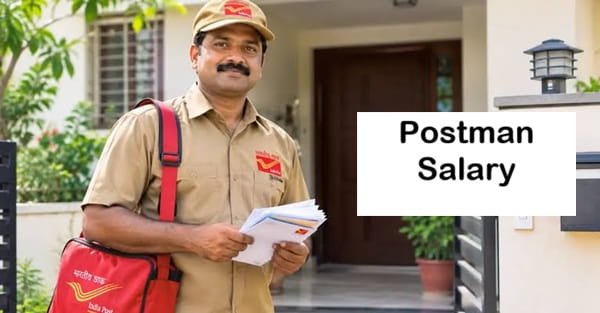
Postman salary 2026 figures begin at a basic pay of ₹21,700, the first stage of Pay Level 3 in the 7th Pay Commission matrix. With DA now at 60%, a new Postman in a metro takes home about ₹43,300 a month, and one in a small town roughly ₹37,300. That’s more than double what a Gramin Dak Sevak earns for a four-hour slab. It’s also why so many GDS sit the departmental exam the moment they become eligible.
| Postman Pay 2026: Quick Facts | Details |
| Pay Level | 3: ₹21,700 – ₹69,100 |
| Dearness Allowance | 60% (from January 2026) |
| In-hand, X city | ~₹43,270 |
| In-hand, Y city | ~₹38,220 |
| In-hand, Z city (no CGHS) | ~₹37,300 |
| Same pay as | Mail Guard |
| Main entry route | GDS departmental exam after 5 years’ service |
| Next promotion | Postal Assistant (Level 4, ₹25,500) |
Postman Salary In Hand: Three Cities, One Pay Level
Every Postman in India starts on the same basic. What changes is HRA, transport allowance and medical cover. The CGHS contribution at Level 3 is ₹250 a month; where CGHS doesn’t exist, a ₹1,000 Fixed Medical Allowance replaces it. NPS takes 10% of basic plus DA.
| Component (₹) | X City | Y City | Z City |
| Basic pay | 21,700 | 21,700 | 21,700 |
| DA @ 60% | 13,020 | 13,020 | 13,020 |
| HRA | 6,510 | 4,340 | 2,170 |
| Transport Allowance + DA | 5,760 | 2,880 | 2,880 |
| Fixed Medical Allowance | — | — | 1,000 |
| Gross | 46,990 | 41,940 | 40,770 |
| Less: NPS | 3,472 | 3,472 | 3,472 |
| Less: CGHS | 250 | 250 | — |
| Approx. in-hand | ~43,268 | ~38,218 | ~37,298 |
No income tax applies. Annual income sits far below the ₹12 lakh rebate limit under the new regime.
A small note on the Y-city column: some Y cities fall under the higher transport allowance list, which would add about ₹2,880. Your division’s pay office will confirm which rate applies.
Why So Many Websites Say ₹28,000–35,000
Search around and you’ll find Postman salaries quoted as low as ₹28,000 to ₹35,000, allowances included. Those figures were mostly built when DA sat far below today’s 60%. At 17% DA, for instance, DA on ₹21,700 was about ₹3,700. Today it’s ₹13,020.
That single difference accounts for over ₹9,000 a month. So if an article’s arithmetic looks thin, check which DA rate it used before trusting the total.
The GDS-to-Postman Leap
For most Postmen, the job doesn’t start with an open-market exam. It starts as a Gramin Dak Sevak.
GDS become eligible for the Postman/Mail Guard departmental exam after five years of service, according to preparation portals. The move is a jump in category, not just pay:
| GDS (ABPM, 4-hour slab) | Postman (Z city) | |
| Basis of pay | TRCA ₹10,000 + DA | Level 3 basic ₹21,700 + DA |
| Monthly take-home | ~₹16,000 | ~₹37,300 |
| HRA / Transport Allowance | No | Yes |
| Pension | GDS gratuity and discharge scheme | NPS, with UPS option |
| Status | GDS engagement rules | Regular central government employee |
That’s roughly ₹21,000 more a month in a small town, plus the full allowance structure a GDS never sees. Five years of patience and one exam separate the two columns.
GDS can also take the Multi-Tasking Staff exam after three years, which moves them to Level 1. Some aim for MTS first, others wait for the Postman exam and skip a step.
Postman and Mail Guard: Same Pay, Different Days
The same departmental exam fills both posts, and both sit at Level 3. The work diverges sharply.
Postmen run delivery beats: letters, parcels, speed post, money orders, and increasingly IPPB doorstep banking and Aadhaar-linked services. Days start early with sorting and end when the beat is cleared.
Mail Guards work with the Railway Mail Service, escorting and handling mail bags on trains and at transit sections. Expect irregular hours and overnight duty rather than a fixed neighbourhood route.
Pay on paper is identical. Travel-related claims and duty patterns make the lived experience quite different, so pick based on the life you want, not the payslip.
Beyond the Payslip
A regular Postman also gets:
- CGHS where available, or FMA elsewhere
- Leave Travel Concession on the central scale
- Children’s Education Allowance
- NPS, with the Unified Pension Scheme available as an option
- Annual increments of about 3%, plus DA revisions every January and July
When the expected July 2026 DA rise to 63% gets approved, a Postman gains about ₹650 a month. The 8th Pay Commission was constituted in November 2025, but no fitment factor has been officially announced. Figures floating online are speculation until the report lands.
Next Rung: Postal Assistant
Postmen can move to Postal Assistant or Sorting Assistant at Level 4, starting at ₹25,500, through the departmental exam route. That shifts the job from delivery to counter and processing work, with a better long-term ladder towards supervisory posts.
If promotion stalls, MACP guarantees a pay-level upgrade at 10, 20 and 30 years of service regardless.
How People Get In
There are two doors:
- Departmental exam from GDS, which is how most Postman posts are filled
- Direct recruitment by postal circles, including sports-quota drives, notified circle by circle
We didn’t find a nationwide direct Postman recruitment notice for 2026. Circle-level notifications appear periodically, so keep an eye on your own circle’s page on the India Post website rather than waiting for an all-India exam.
FAQs
Q. What is the Postman salary per month in 2026?
A new Postman takes home about ₹43,300 in an X-class city, ₹38,200 in a Y-class city, and ₹37,300 in smaller towns, based on ₹21,700 basic and 60% DA.
Q. How can a GDS become a Postman?
After five years of GDS service, you can sit the departmental exam for Postman or Mail Guard. Passing it moves you onto the regular Level 3 pay scale with full allowances.
Q. Is Postman salary the same as Mail Guard salary?
Yes. Both posts sit at Pay Level 3 with ₹21,700 basic pay. Postmen handle delivery beats, while Mail Guards work with the Railway Mail Service on trains and transit sections.